Grant Strategies for Uncertain Times This Giving Tuesday
As Giving Tuesday approaches, many nonprofit leaders are feeling a mix of hope and hesitation. The...


A grant funding strategy is a structured plan that guides an organization through the entire funding process, ensuring team alignment with defined goals over a specific timeframe. Without such a strategy, nonprofits and research groups risk wasting time on ill-matched opportunities and submitting proposals that lack focus. A strategic approach helps organizations plan their resources, prioritize grants with the best odds of success, identify funding gaps, anticipate program needs, and improve overall efficiency.
Building a successful grant funding strategy goes beyond writing proposals. It involves thorough research, relationship building, and long-term stewardship. The six key elements of a grant fundraising strategy are setting clear fundraising goals, finding well-matched grant funding prospects, building strategic relationships with grantmakers, writing compelling proposals, and managing grants and reporting on their outcomes.
Here are 6 elements of a successful grant funding strategy: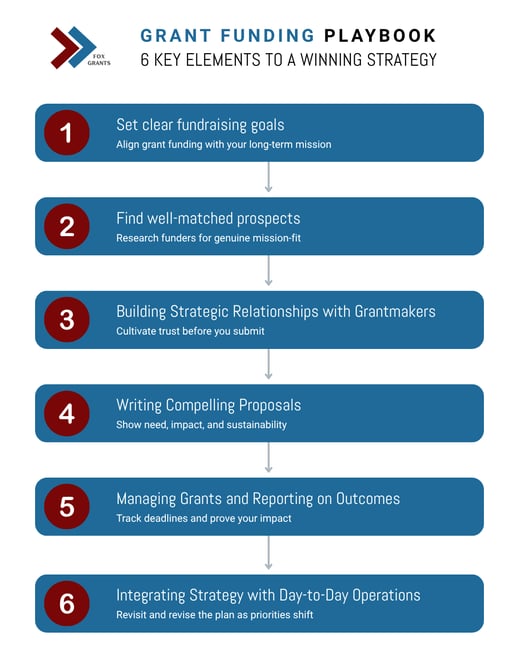
The foundation of any grant strategy is a clear understanding of what the organization aims to achieve. Articulating long-term goals and delineating the role that grant funding will play in reaching those goals is an essential first step. Organizations should map an ideal funding trajectory that aligns with their mission, then make a detailed plan, work the plan, and regularly revisit and revise it as circumstances change.
A grant strategy should complement the nonprofit’s overall strategic plan and provide the funding necessary to accomplish it. Rather than treating grant seeking as a separate activity, successful organizations integrate it into broader fundraising efforts that may also include individual giving, corporate sponsorships, events, and earned income. A sustainable fundraising plan includes multiple income streams beyond grants alone.
Thorough research is critical to identifying the right funding opportunities. Effective grant prospecting begins broadly with industry research, then narrows by mission alignment, leverage of existing relationships, and an honest evaluation of organizational readiness. Starting small with pilot projects can improve the odds of funding, as can publishing results, serving as a grant reviewer, and applying consistently.
Funding sources typically fall into three categories: public grants from federal, state, and local governments; private grants from foundations and corporate giving programs; and blended funding approaches that combine multiple sources. A strategic funding program plans for each type and allocates effort based on the best match between funder interests and the organization’s strengths.
Consistency in performing basic grant-seeking activities is key to building a robust funding pipeline and securing long-term funding. Organizations that set aside regular time for research, networking, and proposal development are more likely to build a steady flow of applications and awards.
One of the most important elements of a successful grant funding strategy is cultivating relationships with funders before submitting a proposal. This targeted cultivation approach contrasts with the “spray and pray” method of sending proposals to every prospect regardless of fit. Cultivating fewer, well-matched prospects delivers better results because funders appreciate organizations that take the time to understand their priorities.
Successful grant applications often begin with robust community engagement before the grant pursuit even starts. This engagement builds trust and demonstrates that the organization is connected to the needs it aims to address. Collaboration with partners also strengthens grant applications and is increasingly valued by funders. Strategic relationships open doors to informal feedback, pre-application discussions, and long-term stewardship that extends beyond a single grant cycle.
Building a grant-seeking team with defined roles helps organizations manage relationships effectively. The team should plan funding priorities and categorize grants into three groups: existing relationships where the organization already has a connection, connections that can be leveraged through board members or partners, and reach grants that require cold applications.
Winning grant proposals include a strong needs statement, a clear solution, demonstrated impact, and a sustainability plan. The proposal must show how the organization’s work directly addresses a documented problem and why the funder’s investment will make a measurable difference. Tailoring each proposal to the specific funder’s guidelines and priorities is non-negotiable.
The more feedback an applicant solicits prior to submission, the better the grant will be. Organizations should plan to have a final draft completed with enough time to proofread and incorporate feedback from colleagues, board members, or external reviewers. This iterative process catches errors, strengthens arguments, and ensures the proposal meets every requirement.
Return on investment from grant seeking includes skills, relationships, prestige, and money. Even when a proposal is not funded, the process of writing it builds institutional knowledge and rapport that may pay off in future submissions. Consistent effort and continuous improvement matter more than any single proposal.
A successful grant funding strategy does not end with the award letter. Ongoing management and reporting are essential for maintaining funder trust and demonstrating accountability. Developing a comprehensive grant calendar helps organizations track deadlines for progress reports, financial statements, and final evaluations.
Executing a grant strategy requires thoroughly researching grants, tailoring proposals, and submitting applications on time. After the grant is awarded, organizations must meet reporting requirements and communicate regularly with the funder. Ongoing reporting and adjustment through quarterly progress tracking, feedback collection, and continuous refinement are essential for long-term success. Funders are more likely to renew or expand support when they see transparent, timely reporting.
A grant strategy is not a one-time document. It is a living framework that guides resource allocation, staff responsibilities, and decision-making throughout the year. Organizations should revisit and revise their strategy regularly to reflect new opportunities, changes in funder priorities, and lessons learned from previous applications.
The steps for grant funding strategy development are straightforward: articulate long-term goals, delineate the role of funding, map an ideal funding trajectory, make a plan, work the plan, and revisit and revise regularly. This cycle keeps the strategy aligned with the organization’s evolving needs and the external funding landscape.
Many organizations find it helpful to form a grant-seeking team with defined roles covering research, writing, budgeting, and reporting. By planning funding priorities and categorizing grants into existing relationships, connections, and reach grants, the team can focus its energy where it is most likely to succeed. A well-maintained grant calendar ensures that no deadlines are missed and that reporting obligations are met on time.
The timeline varies based on the organization’s size and experience. Developing a basic strategy can take several weeks to a few months, but the process is ongoing. Most experts recommend revisiting and revising the strategy at least quarterly to keep it responsive to changes in funding priorities and organizational goals.
No. A sustainable fundraising plan includes income streams beyond grants, such as individual giving, corporate sponsorships, events, and earned income. Grants should complement these other sources, not replace them. Relying solely on grants can create vulnerability if funding priorities shift.
Small organizations can start by forming a small grant-seeking team with defined roles, even if those roles are part-time. They should prioritize a few well-matched prospects rather than applying broadly. Leveraging board connections and collaborating with partners can also extend capacity without additional hires.
A strong needs statement combined with a clear solution and demonstrated impact are the core components. Funders want to see that the organization understands the problem deeply and has a realistic plan to achieve measurable results. A sustainability plan that shows how the work will continue after the grant ends is also critical.
Building a successful grant funding strategy takes deliberate effort, but organizations that invest in the full process—from goal setting to stewardship—are far more likely to secure the funding they need to fulfill their mission.
The difference between organizations that consistently win grants and those that struggle isn't luck—it's strategy. With the right funding plan, targeted prospect research, and expertly written proposals, you can spend less time chasing opportunities and more time advancing your mission.
At Fox Grants, our experienced grant professionals help nonprofits, researchers, schools, and mission-driven organizations secure the funding they need through customized grant strategies, prospect research, proposal writing, and grant management support.
Don't leave funding on the table. Schedule a consultation with Fox Grants today and discover how a strategic approach to grant funding can help your organization win more grants, increase revenue, and create lasting impact.